
Fortresses and Monopolies
The Portuguese, Spanish, Dutch, and English in Maluku

Introduction
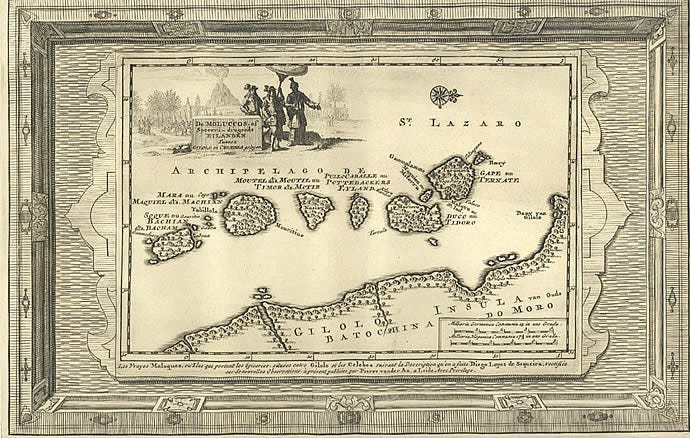
The early modern history of the Maluku Islands illustrates the intersection of local politics and global commerce in a region that became central to European expansion. From the arrival of the Portuguese in 1512 to the consolidation of Dutch power in the seventeenth century, the islands of Ternate and Tidore served as strategic outposts for competing colonial powers. In this article I will examine how European fortifications, monopolistic trading practices, and alliances with local rulers transformed the region, highlighting the interplay between imperial ambition and indigenous resistance.
Early Portuguese Arrival (1512–1529)
In 1512, the Sultan of Ternate invited the Portuguese to his island, intrigued by their advanced weaponry and naval power. He sought their support to strengthen his position against his rival, the Sultan of Tidore.
The Portuguese were well received. Captain Francisco Serrao established close ties with the Ternatan court, marrying into the royal family and serving as adviser to the Sultan. In return for constructing a fort and providing arms, the Portuguese obtained permission to establish a trading post and monopoly over the clove trade.
Meanwhile, the Spanish established relations with Tidore, balancing Ternate’s alliance with Portugal. However, Spain soon reassessed its commitment. By 1529, King Charles of Spain recognized that sustaining direct influence across the Pacific was economically impractical. Under the Treaty of Zaragoza, Spain sold its claim to the Spice Islands to Portugal for 350,000 gold ducats, redirecting its colonial focus toward the Philippines. This agreement redefined spheres of influence, linking Manila to Acapulco and Europe in a global trade network centered on silver, spices, and Asian luxury goods. Peruvian-minted silver coins, popularly called “pieces of eight,” became a widely accepted currency across Asia and the Indies.
Turbulence and Rebellion (1530s–1575)
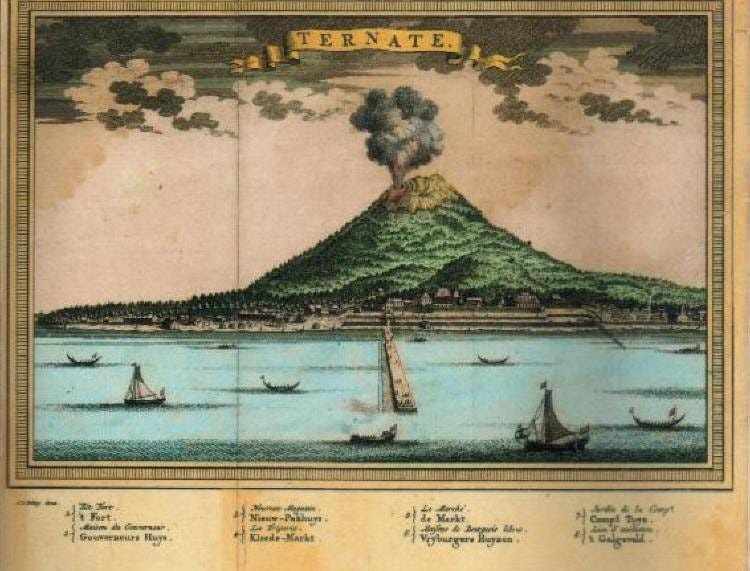
Despite holding exclusive control, Portugal faced persistent challenges in Maluku. Fort Gamalama was garrisoned with exiles and marginal recruits from Portugal, leading to corruption and unregulated private trade. Political rivalries between Ternate and Tidore further drew the Portuguese into local disputes.
In 1546, the Jesuit missionary Francis Xavier arrived in Ternate, aiming to convert the population to Christianity. While he secured a favorable relationship with the Sultan, the mission met resistance from local communities who opposed religious intervention.
Over time, mismanagement and recurrent unrest weakened Portuguese authority. On December 31, 1575, after sustained rebellion, Portuguese forces capitulated and withdrew. The Sultanate of Ternate subsequently reestablished commercial ties with regional partners including Javanese, Arabs, Gujaratis, and Achenese, ushering in a brief resurgence of prosperity.
New Rivals: English and Dutch Appear (1579–1605)
In 1579, Sir Francis Drake visited Ternate, where the Sultan proposed an alliance against the Portuguese presence in nearby Tidore. Although Drake showed interest, the encounter was short-lived. The political situation changed significantly after 1581, when Spain and Portugal were united under King Philip II. A joint Spanish-Portuguese expedition to retake Ternate in 1585 failed, reinforcing the volatility of European ventures in Maluku.
The Dutch entered the region in 1596, initially with little success. A subsequent expedition in 1598, however, returned substantial profits, prompting further involvement. In 1601, Dutch ships arrived in Ternate, where the Sultan encouraged them to act against the Portuguese. Although hesitant to intervene directly, the Dutch nonetheless signaled their presence by firing on Fort Mariaco. In the same year, the English also initiated limited trade, foreshadowing greater competition.
In 1602, the Dutch organized their commercial ventures under the United East India Company (VOC). By 1605, the VOC launched a successful campaign against Portuguese forces in Ambon, marking the beginning of Portugal’s decline in the Spice Islands.
Battles for Dominance (1606–1667)
By the early seventeenth century, Ternate and Tidore became focal points of overlapping European ambitions. The Sultan of Ternate maneuvered carefully, conducting covert trade with the English while maintaining neutrality with Tidore. His strategy aimed to exploit rivalries among European powers to preserve local autonomy.
Conflict intensified when the Dutch clashed with Portuguese forces. Initially on the defensive, the Portuguese were ultimately defeated after their fort was destroyed in an accidental fire. In 1606, however, the Spanish returned from Manila, allied with Tidore, and briefly regained control of Ternate, ending the Sultanate’s golden age.
The Dutch quickly reestablished their presence, securing a base on Ternate. In 1609, they agreed to a truce with Spain, which eventually abandoned direct interests in Maluku to focus on Manila. Nevertheless, the Dutch increasingly extended their control, especially under Governor-General Jan Pieterszoon Coen, whose aggressive policies sought not merely trade but territorial dominance.
The Dutch simultaneously tightened their grip over Banda and Maluku’s clove production. They transplanted clove trees to Ambon, compelling villagers to maintain quotas of one hundred trees per household, with destruction or neglect punishable by death.
In 1623, the Dutch consolidated control further after executing seventeen English merchants in Ambon, accused of conspiracy in what became known as the Amboyna Massacre. The 1667 Treaty of Breda formalized English withdrawal, exchanging the island of Run for Manhattan. To regulate supply and maintain high prices, the VOC even destroyed surplus cloves.
The VOC’s Ascendancy (1667–1798)
Although the Dutch established monopoly control, smuggling continued via Makassar, supported by producers from Ternate, Tidore, Halmahera, and Ceram. A Dutch assault on Makassar in 1660 failed, but in 1667 they succeeded with the assistance of the Bugis ruler of Bone, consolidating VOC dominance.
At its height, the VOC functioned as the wealthiest corporation in the world, commanding vast fleets, maintaining fortified trading posts, and employing tens of thousands of personnel. Yet by the late eighteenth century, the monopoly system faltered. Pierre Poivre, a French administrator, smuggled clove and nutmeg seedlings to establish cultivation outside Maluku, undermining the Dutch trade advantage. By 1798, financial difficulties forced the Dutch state to nationalize the VOC.
Colonial Shifts and European Rivalries (1795–1816)
The late eighteenth and early nineteenth centuries brought renewed instability. In 1795, during the French Revolutionary Wars, the Dutch king fled to London and ceded overseas territories to Britain. British forces briefly occupied Tidore and surrounding islands, but the 1802 Treaty of Amiens restored Dutch control.
Napoleon’s rise again disrupted the balance. In 1807, Willem Daendels was appointed governor-general, placing the colony under French influence. British forces invaded Java in 1811, installing Stamford Raffles as governor-general. Following Napoleon’s defeat, the 1816 Peace of Paris restored Dutch sovereignty over the East Indies.
Conclusion
The history of Ternate and Tidore from the sixteenth to early nineteenth century demonstrates the extent to which local sultanates became entangled in global rivalries. European fortresses and monopolistic practices reshaped trade networks, while indigenous resistance continually challenged foreign domination. Ultimately, the Maluku Islands served not only as a battleground for empire but also as a critical node in the early modern world economy, linking Asia, Europe, and the Americas through the pursuit of spices.