
Watch the Skies
Sci-Fi Movies of the 1950s and How They Reflected the Anxieties of the Era

With the New York City mayoral victory of Mamdani and other electoral victories by candidates calling themselves democratic socialists, President Donald J. Trump and his ungodly minions have been working to revive the Red Scare and McCarthy era that we suffered through over seventy years ago. It was a time of suspicion, paranoia, looking under the bed for communists– who knows your neighbor may be one of those commies – and the fear of nuclear annihilation. Those of us who lived through that period may remember hiding under our desks as practice for when the commies sent over the nukes.
If you think all of this is a thing of the past, Heather Cox Richardson, the American historian wrote recently: “Yesterday President Donald J. Trump, Secretary of State Marco Rubio, and deputy White House chief of staff Stephen Miller all threw the weight of the U.S. government behind a far-right conspiracy theory that says Trump and his loyalists are defending the United States of America against a communist takeover..“
So is history repeating itself?
Let’s talk about the sci-fi films of the 1950s. This week it’s the Red Scare, McCarthyism and fears of nuclear annihilation. Of course, when I watched these as a boy at the Roxy Theater, I wasn’t aware that they were anything more than cool science fiction movies, but during my undergraduate years at the University of Illinois, Chicago, I took a course on writing film criticism. It was one of those “maybe-I’ll-do-this-for-a-living” courses before I discovered anthropology. One of my essays was on how the Red Scare was depicted in two of the films that I am going to mention in this essay: The Blob and The Thing from Another World.
Let’s take a look at four classic films of the 1950s that serve as metaphors for the communist menace or as a warning of nuclear destruction.
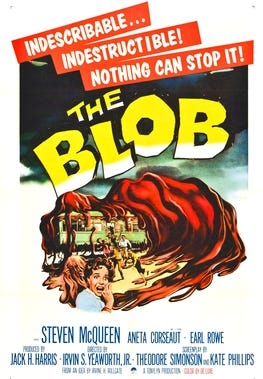
1. The Blob (1958): I remember seeing The Blob with some of my buddies at the old Roxy Theater in Berwyn, Illinois. Steve McQueen had his first starring role in the movies in this film. His performance was not considered stellar by critics, but for us kids, he was cool. Actually, he was 27 at the time, but we didn’t know that. At the time, the movie resonated for me and my buddies with the feeling that sometimes adults just weren’t very understanding of or receptive to kids.
Plot Summary
The Blob is encased inside a meteor that strikes Earth outside a small town. Two teenagers, Steve Andrews (Steve McQueen) and Jane Martin (Aneta Corsaut), are making out teenagers, Steve Andrews (Steve McQueen) and Jane Martin (Aneta Corsaut) are making out on the outskirts of their small town. They see the meteor hit Earth and take off to have a look. But, as things work out, an old man living alone in a remote cabin discovers the small meteor and pokes it with a stick. It breaks open and something like a popular kid’s toy, slime attaches itself to the stick and then creeps up onto the old man’s arm. Steve and Jane almost hit the man as he runs across a road in pain. Steve wraps the man’s hand in his coat, and they head for Doc Hallen’s office for help. The Blob consumes the old man and then the doctor’s nurse and finally the doctor himself. Each time the Blob consumes a human, it grows larger.
Steve and Jane notify the police. Three cops work in the station: the lieutenant is sympathetic to Steve’s story; however, the younger sergeant has a grudge against teens because
his wife was killed in a car accident by a teenager. He continually pushes against the teens in the movie until close to the end. A third officer is somewhat nonchalant about the whole thing. He is more interested in playing chess over the phone with a cop from another city.
Eventually, Steve and Jane are trapped in a walk-in freezer with the Blob trying to enter the freezer under the door. When it gets partly into the room, it retreats because of the cold. Aha— Chekhov’s gun in action.
After being unable to convince the adults of the existence of the Blob, Steve and Jane rally the teens in town who get in their cars, horns honking, and set off the town’s fire and air raid alarms. Townspeople gather, but still no one believes in the teens until moviegoers come screaming out of the local theater where the Blob is devouring the audience. Eventually using CO-2using CO2 fire extinguishers (remember the freezer!), they freeze the Blob and an Air Force cargo plane takes the Blob to the Arctic where it drops the Blob. The ending scene says: The End followed by a question mark. We loved the ending. Scary enough for a group of pre-adolescents.
The Blob has become a cult B-movie, especially noticeable because of Steve McQueen starring role. It’s a perfect film for the drive-in culture that was developing in the US at the time.
The Blob has been analyzed by a number of writers and film critics as a metaphor for the slow, creeping spread of communism. The Blob’s color becomes increasingly red as it consumes one citizen after the next. These citizens become just a part of an enormous mass without any individuality.
The Blob, an unknown alien force, arrives in a rural town where its presence can initially go undetected. The setting in a small town adds to the tension in the film. Rural setting for sci-fi horror films continue up to the present as can be seen in Stranger Things, for example.
As the Blob becomes larger, it becomes impervious to traditional weaponry, but cold can stop it, and the cold in the movie is applied by a group of citizens acting together to rid themselves of this alien presence that is consuming a traditional way of life. Remember back when this movie was filmed, America still had a more rural feel. This was the real America where everyone knew everyone else, and they worked together to keep peace and order in their community. The Blob calls for unity despite differences and misunderstandings among the American people in response to threats from outside.
2. Invaders from Mars (1953)
The Blob was criticized for both the acting and the writing, but compared to Invaders from Mars, The Blob was a masterclass in teenage sci-fi horror. Nevertheless, Invaders from Mars is considered another cult classic of the 1950s sci-fi horror films.
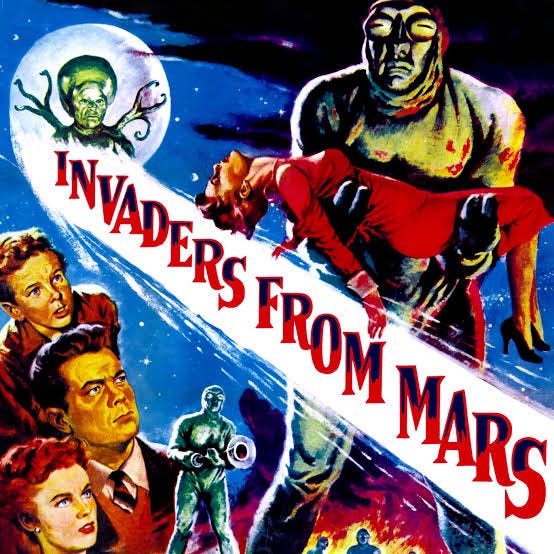
There is an annoying amount of stock footage of tanks rolling into the area where the alien spaceship has landed. None of this is necessary to the film unless they just wanted to expand the run time. But what happens here? This time it isn’t a blob or pods that invade the earth. The invaders are actual Martians although they are the strangest Martians that I’ve come across in 70 years of watching sci-fi alien invasion flicks. They look like they are wearing kids’ green pajamas and despite all the humans being terrified of them, I found them more awkward and silly than anything else. The head Martian (actually a head that doesn’t speak, but has a lot of eye movement) has some kind of tentacles growing out of its shoulders. The head is encased in a glass globe.
Plot Summary
David MacLean (Jimmy Hunt) is a young boy and an amateur astronomer. His father, George (Leif Erickson), is an engineer on a classified project. David awakes one night and witnesses an alien spacecraft landing in a sand pit in the back of his house. He tells his father who goes to investigate and is promptly sucked underneath the sand. In the morning, David and his mother notice that Dad is acting strange and surly, unlike the jovial, loving Dad at the start of the film. In fact, at one point, Dad is irritated enough with his son that he backhands him hard enough to knock him down to the floor. And Dad is, in my opinion, the scariest thing in the whole movie.
David notices a red mark on the back of his dad’s neck. This is an important point because David uses that observation to tell which adults have been taken over by the Martians. The mark is where a radio receptor has been implanted in order to control the humans. Eventually David’s mother, Mary (Hillary Brooke), is made into an alien puppet, as are the police chief, a general from the army and several policemen and soldiers.
Like in The Blob, David tries to warn adults of what is happening, but once again no one pays him much attention. Eventually David wins over Dr. Blake (Helena Carter), a public health official, and then the local astronomer, Dr. Kelston (Arthur Franz). The trio work together to get the military on their side. The spaceship is discovered, the tanks come rolling in. David and Dr. Blake are captured momentarily by the Martians, but are eventually rescued. The military battle the pajama-clad aliens and plant a bomb inside the spaceship. As all the humans flee the ship and watch it emerge from beneath the sand, the ship explodes mid-air. The film ends with David waking in his bed from a nightmare, and then seeing the spaceship land again. However, in my version of the film, the ending has David in his bed with Dr. Blake and Dr. Kelston looking over him.
The original print quality that I recently watched was terrible, but a 4K restoration is supposedly excellent and highlights the designs of William Cameron Menzies. This is the first sci-fi film of the 1950s to show alien spacecraft in color so there is that. And there is a strange, dream-like quality to the film, which fits in with the story being told from a child’s point of view. I loved this movie as a kid, but now, for me, it’s one of those - it’s so bad that it’s good- films.
Invaders from Mars is full of the paranoia common in sci-fi films of this period. And like The Blob there is a distrust of authority figures and a fear of not knowing who to trust even within the family. The citizens that are under the mind control of the aliens look the same, know the same things, but their behavior is different, more aggressive. The aliens, the enemy, are hidden just below the surface on the one hand, and in plain sight in the guise of the mind-controlled citizens on the other. An interesting trope here is that scientists can be trusted to do the right thing; to be logical and work out solutions to existential problems using science rather than mindlessly following the orders of authority figures. Scientists don’t always come out so good as we’ll see in another film from the 1950s: The Thing from Another World.
3. It Came from Outer Space (1953)
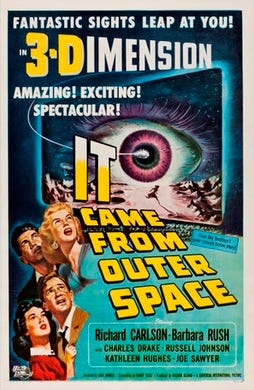
It Came from Outer Space is one of the few sci-fi films from the 1950s that has an unusual, more positive take on aliens coming to Earth. While most films during this period, depicted the negative, terrifying aspects of an alien presence, this film gives a more sympathetic treatment of aliens. The film was based on a story by the legendary science fiction writer, Ray Bradbury. Rather than arriving as conquerors, the aliens arrived by accident. And, while trying to hide their presence on Earth like the Martians of Invaders from Mars in order to carry out their nefarious activities, these aliens hid their presence in order not to frighten humans and create misunderstandings. The movie was filmed in 3-D.
Plot Summary
A writer and amateur astronomer, John Putnam (Richard Carlson) and his fiancée, Ellen Fields (Barbara Rush) see what appears to be a meteor crash to Earth. Along with a friend who is a helicopter pilot, they visit the site of the crash. Putnam descends to the bottom of the crater that was created by the crash and discovers what appears to be a spaceship. However, a sudden rock slide buries the ship before the others can see it. Putnam tries to tell other people about what he has seen, but no one believes him, and a reporter writes a story branding him as a kook. Fortunately for Putnam’s reputation and sanity, some townspeople begin to mysteriously disappear and when they reappear, they seem strange. We later find out that the aliens can duplicate humans but don’t quite get the whole human personality right. Two of the aliens are killed.
Putnam eventually meets with the aliens who explain that they just want to leave the planet peacefully, and that they assume human form because their actual physical appearance would be too terrible for people from Earth to experience. When Putnam presses an alien to show his true form, he does and Putnam is shocked and disgusted. Nevertheless, he agrees to help the aliens stay hidden while they make repairs on their ship. A few people are taken hostage by the aliens in order to protect themselves. Putnam’s fiancé is among the hostages. He tells the sheriff where the alien spaceship is located with the hope that he will leave the aliens alone until they can leave.
However, the sheriff, consumed by fear of the unknown, gathers a posse with the purpose of killing the aliens and rescuing the hostages. Putnam beats the posse to the aliens’ location, kills one in a fight based on the fear of both of them, but then convinces the alien leader not to destroy themselves, which they want to do rather than be killed or captured by the humans. He blocks the entrance to the mine where the aliens ship is located, and the posse arrives intent on violence, but the aliens are able to leave Earth and continue on with their journey.
The movie ends with Putnam saying to his fiancée, “It wasn’t the right time for us to meet. But there will be other nights, other stars for us to watch. They’ll be back.
It Came from Outer Space had mixed reviews when it was originally released, however, as with many of the films discussed here, contemporary reviews have been much more positive. Rotten Tomatoes gives the film an 81% critics’ score.
As I previously mentioned, It Came from Outer Space, presents a different message than most of the sci-fi films of the 1950s. The same elements of the other films are evident in that there are mysterious outsiders, people disappear without explanation, ordinary people begin acting strangely and the result is public panic. However, Bradbury’s script turns the usual formula on its head. The “enemy” is actually not the enemy. The real enemy is the local population, who, driven by xenophobia, ignorance, and hysteria, resort to violence.
So the film confronts this atmosphere in the town and accordingly the atmosphere created by McCarthyism. The character of Putnam shows that scientific inquiry along with compassion, empathy, restraint and reason are preferable in dealing with the unknown.
The themes of xenophobia, misinformation and mindless acceptance of group dynamics are particularly relevant today with the current administration demonizing outsiders (immigrants), scientists, and those with progressive ideas.
Two geek facts: Russell Johnson plays George in the film. Johnson was later to become famous as the Professor in Gilligan’s Island. Barbara Rush won a Golden Globe as Most Promising Newcomer for her role in the film.
4. The Thing from Another World (1951)
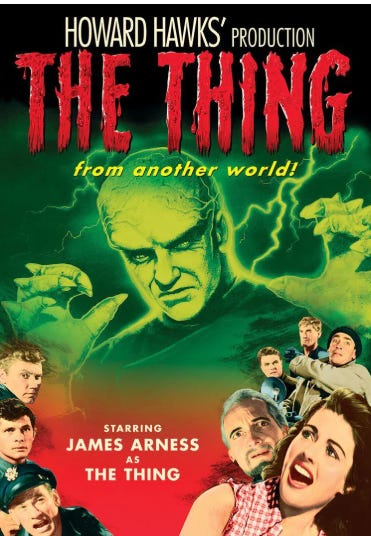
The Thing from Another World, often just referred to as The Thing, is one of the earliest films of the 1950’s sci-fi genre and as such, it played a large role in setting the framework and themes for the alien invasion films that followed. The film is notable for the dialogue, which unlike the wooden dialogue in many of the sci-fi films is more realistic with people speaking over others, making small, sometimes awkward jokes, and just generally sounding more like people actually talk.
Plot Summary
The film takes place in a US Air Force research base in the Arctic. The location is an important element in the film because its isolation and harsh conditions play an important role in how the humans deal with the Thing. Scientists at the station discover a spaceship that has crashed into Earth. Attempting to excavate the ship, they blow it up by accident but find a figure encased in ice. They bring it back to the station to study it.
Captain Patrick Hendry (Kenneth Tobey) is the ranking Air Force officer. Unlike in some sci-fi films, the military is actually more rational than the scientists. Hendry tries to work with the lead scientist, Dr. Arthur Carrington (Robert Cornthwaite) even as he becomes increasingly irrational. Nikki Nicholson (Margaret Sheridan) is a secretary for the scientists. She plays an important role in eventually siding with the military when she notices Carrington’s behavior.
The creature is accidentally thawed out by an airman. It is revealed to be a humanoid-looking creature that is actually a plant that lives on blood. The Thing begins attacking humans and the station’s dogs. When the Thing shuts off the oil needed to heat the station, everyone understands that they are dealing with a highly intelligent being. Carrington, in the meantime, has an experiment going where he is using the station’s plasma supply to feed some seedlings from the Thing’s arm which has been torn off during a battle with the station’s dogs. At this point, most of the scientists begin to question Carrington’s actions.
Hendry and Carrington begin to clash because Hendry realizes the threat to the station’s personnel, while the scientist wants to communicate with the Thing because he sees it as a superior life form even though this intelligent plant is already in the process of snacking on the humans and the dogs.
At this point most of the people join together to try to kill the Thing before it kills them despite orders from military command to not kill it along with Carrington’s obsession with saving the creature even if it means that it will kill all of them. He continually brings up the primacy of science over their lives. The loss of everyone’s lives at the station are an acceptable price to pay in the primacy of science.
Eventually, Carrington approaches the creature and tries to communicate with it. Obviously not in a talking mood, the Thing knocks him against a wall and prepares for lunch. The group has set up a trap, however, to electrocute the creature. The plan works, the Thing is reduced to ash and the seedlings are destroyed.
A reporter, Ned Scott (Douglas Spencer), who has been looking for a story but has been kept from publishing is finally given the go ahead. He contacts the press at the Anchorage station where the film began. He ends the movie with one of the most famous endings in sci-fi history - “Tell the world. Tell this to everybody, wherever they are. Watch the skies everywhere. Keep looking. Keep watching the skies.”
The Thing has been interpreted by historians, film critics and others as a metaphor for the Cold War. The creature is an alien – not one of us. It is an unknown, powerful force invading the United States and potentially destroying the American way of life. However, unlike other films that followed The Thing, the alien doesn’t speak and doesn’t communicate its intentions. Its spaceship was destroyed so there is no evidence as to why the ship arrived on Earth. While it is intelligent, it seems more interested in food than in conquering the country or the planet.
I found the tension between the military and the scientists the most interesting aspect of the film. The Thing is obviously a danger. There is no evidence as to its ability or interest in communicating with the humans that it encounters. It seems to be an unstoppable force with the sole intention of killing and sucking the blood of all living creatures.
While the scientists are not portrayed as evil—including Dr. Carrington, who becomes increasingly irrational—his portrayal highlights his naïvety and the dangers of experimenting with forces that he doesn’t understand. The loss of everyone’s lives at the station is an acceptable price to pay. The military, on the other hand, acts as the rational party in understanding that their main objective is to rid themselves of a clear threat.
Thus the film represents the tensions in how to deal with a threat from outside. The military’s approach is to destroy it, while the scientists (mostly Dr. Carrington) want to study it, communicate with it and learn from it. And here, you can see an ambivalence about science and scientists that was common at the time because some of the scientists recognized the dangers of playing with fate, while others did not.
The second aspect of the film is the fear of the new Atomic Age. The alien is highly radioactive and this represents fears and anxieties about atomic power, the arms race and nuclear fallout. It also appears, based on Carrington’s experiments, that the creature has the ability to reproduce. If we look at the film as a metaphor for communism, this can represent the spread of a foreign ideology.
Geek fact: The Thing is played by James Arness who later became famous as Marshall Matt Dillon in Gunsmoke.
End Notes
The 1950s was defined by opposites: rapid economic development after the end of WWII, a feeling that the United States was the undisputed leader of the world, and a move from a rural, more traditional identity to a cosmopolitan identity. All of these worked to establish a vibrant national identity and purpose. Pushing against that positive ethos were the House Un-American Activities Committee (HUAC) hearings, the Cold War, McCarthyism, and a fear of communist infiltration. And thus, the 1950s was also a time of xenophobia, paranoia and a fear of the unknown as we entered the Atomic Age and the possibility of not only individual death from aliens, but total annihilation of the entire species.
A strange dialectic emerged in the 1950s. We see an obsessive concern with individuality and its loss in most of the sci-fi films about alien invasions. Individuality is a symbol of Western capitalist democracies, while conformity, group think or collectivism is a symbol for communist systems. And yet, over and over in these films we see the writer, the scientist, the person with a story to tell that is not in sync with the commonly accepted “knowledge” as being either a “kook” or delusional or as in several films, a child. Individualism is fine as long as it fits in with the common narrative of the world.
These films also portray women in their stereotypical version as swooning, delicate and appropriately submissive. They follow the lead of the male hero without much to say other than banal lines like “Oh Steve, do you think they can be stopped?” The height of the lack of female agency is evident when David’s mother in Invaders from Mars says nothing when her husband knocks his son across the room in a fit of anger. However, in The Thing from Another World, Nikki takes on a much more active role as part of the group that attempts to kill the Thing. Her banter with her boyfriend, Captain Hendry, shows that she considers herself on equal footing with him and the other men at the station. When I discuss The Day the Earth Stood Still in the next essay, we’ll see another strong female character who plays a significant role in the story.
The best science fiction films, in my view, offers a critique of society. They can work both as a mirror – reflecting on our actions on a macro level – and as a microscope – letting us examine what is beneath the surface, the motivations and beliefs that underlie and drive our behaviors. So while the sci-fi films of the 1950s can be seen as a reflection of the anxieties of the times, they were also just fun, and sometimes scary, movies that especially appealed to kids.
Next week, I am going to discuss my two favorite films of the 1950s sci-fi genre: The Day the Earth Stood Still and The Invasion of the Body Snatchers, along with their remakes. I consider both of these films to be more serious and adult-oriented.
Keep watching the skies
Don’t forget The Twilight Zone!! It also had a lot of social commentary & was ahead of its time!
My Indonesian wife’s favorite Si-Fi movie is Mars Attacks. Even though it was made in 1996, I had a collection of bubble gum cards on that subject in the 60’s and the aliens portrayed were the exact same as in the Tim Burton movie. She always cracks up when the Martians start talking: Ack ack ack ack. One of my favorite scenes is when Martin Short picks up the alien disguised as a big chested woman with a big hairdo that hides the big head. I’m not sure about the social commentary other than Slim Whitman yodeling made their heads explode!!