
That Doesn’t Answer My Question
On fate, luck, and what grows in the not knowing

Recently I was thinking about a conversation I had with my granddaughter about god and heaven. Her questions had the intensity of a young girl looking at the beliefs that she had been given from her elders, trying to make sense of them.
Why do some people go to heaven and some people go to hell? Is it our actions while we are here on Earth that determines where we end up? Is our final destination predetermined? I wanted to discover something beyond the Abrahamic religions. Something other than Hinduism or Buddhism.
Eventually I came across Norse mythology and the concepts of Wyrd and Ørlǫg (Orlog). Combing through the extensive literature online about this topic, I came across a worldview not too dissimilar to what I see as my own understanding of life, fate and luck. As I understand them, the concepts are interrelated. Orlog is often translated as “original law” or “primal law.” It refers to the fundamental conditions established at the beginning of existence. These are the deep patterns, inherited circumstances, and cosmic laws that shape the possibilities of a person’s life. We can think of them as cards you are dealt in life: your ancestry, the actions of your forebears, the circumstances of your birth and the underlying structure of the cosmos.
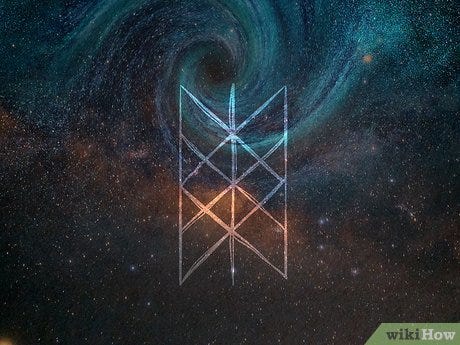
Three Norns, female deities, representing what was, what is and what shall be, sit at the Tree of Life, the Yggdrasil.. They tend the loom of existence and weave your fate, your destiny. The threads that the Norns weave are all interconnected in a mass web of reality. The wyrd is the weaving of your own actions, choices, and consequences that affect not only you, but everything within the web. This is individual choice. It’s not possible to escape the orlog that the Norns weave, or your destiny, but as you make choices, commit actions, you are creating threads, some threads are stronger, some weaker, but all are significant. Wyrd paths or threads can be good or chaotic. They can create opportunities for the future or bad experiences for the future. They can create growth or regression.
Looking at this from an anthropological perspective, Orlog can represent the structural conditions into which a person is born, such as kinship systems, social position, historical circumstances, geographic location and political organization. Wyrd can represent individual life processes and actions within those structures, reproducing or transforming them through practice. What I find compelling with this worldview is its organic nature.
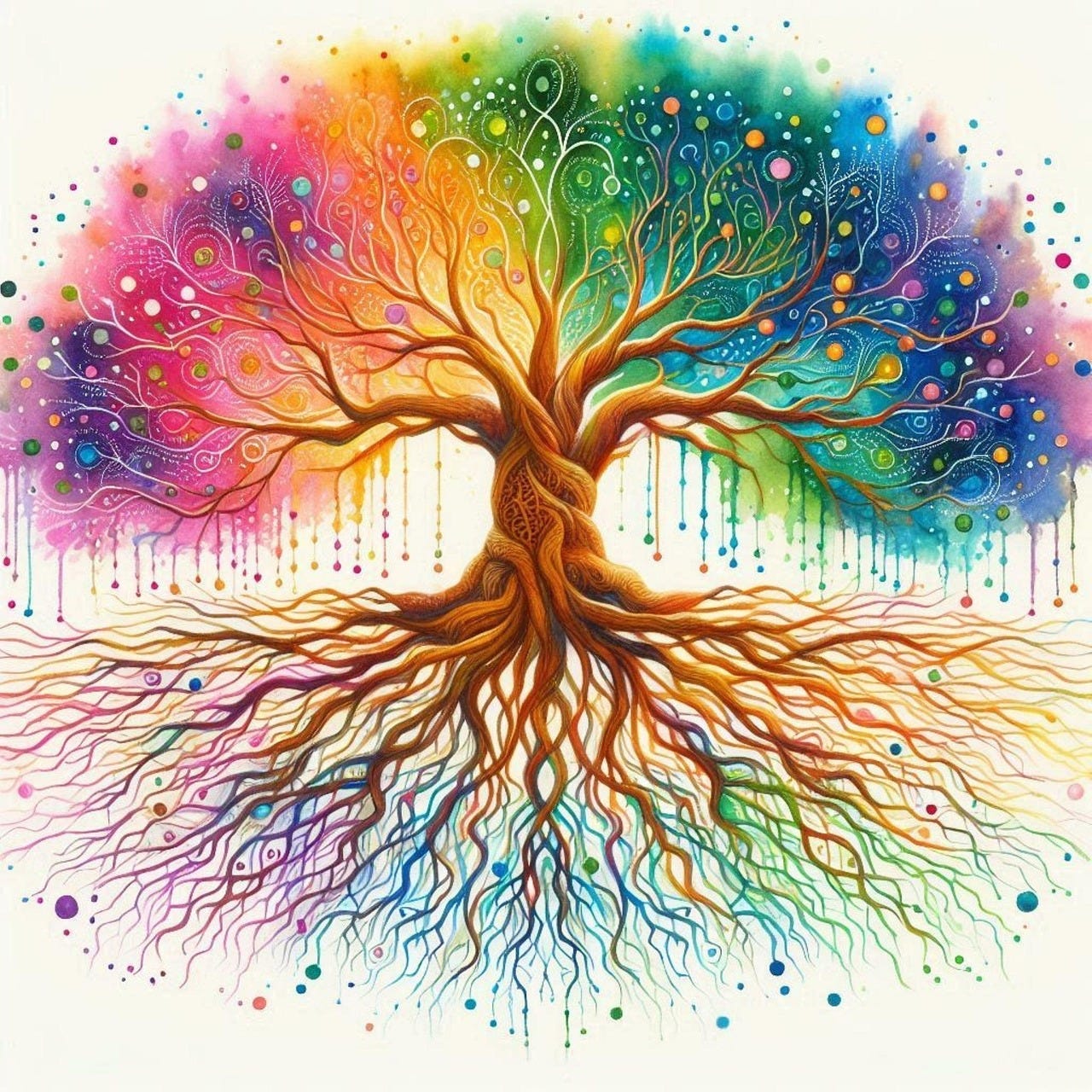
If we go back to the essay that I wrote on linearity, this is the opposite. It’s a dynamic system where there is tension between the structures within which one is born and individual agency. In many ways, the Norse mythological worldview runs parallel to the metaphor that has been developing in my thoughts recently. In my telling of life, the image is a tree rooted in the earth. From the earth come the foundations of existence -- the history before us, the ancestors, their stories, the culture and society into which we are born, our genetic makeup. Our actions, behaviors, thoughts are the nutrients of the tree that flow up through the trunk. They feed the branches. Our actions can use or not use those nutrients. If we use them, the branches flourish and branch out. Each individual action creates new branches, with new choices.
My granddaughter’s questions about god and heaven started me thinking about predestination and free will. But besides fate or destiny, the role of luck in life had also been on my mind. Particularly my life and my luck.
I was having some late afternoon drinks on my balcony with an old friend. A retired psychologist, he and I often grapple with how we came to this place, this fabled island. Pouring himself a healthy measure of scotch, he peered over his glasses and held my gaze for a moment. “You are one of the luckiest people that I have ever met. You go from job to job without so much as a plan. Most of us have a career path, we write resumes, we interview, we wait for a decision. It’s all intentional. Your life seems like a game of chance.”
My immediate instinct was to forcefully argue against such an interpretation of my life, my various careers. But, perhaps due to the half-full bottle of scotch resting on the table between us, my mind wandered a bit to my last job working on a cruise ship as a guest lecturer. A decade ago, I was supplementing my retirement pension doing what I called “hack writing,” I wrote brief articles about a variety of topics for a leading company in what were then called content mills. Eventually search engines (like Google) significantly updated their algorithms to penalize this type of content and thousands of writers, including myself were let go. The day after I received notification that I was no longer able to access articles, an old friend from my days teaching at a small international school in the the mountain rainforests of New Guinea unexpectedly showed up at my house.
Hassan and I sat in the rooftop garden of my house drinking beer, smoking cigarettes and chewing over old times. Suddenly he asked me, “So what are you doing these days, Dr. Bruce?”
I explained about losing the content mill job the day before, and his eyes lit up. Hassan had a certain type of smile that signified that he was about to say something that would get me involved in some new adventure. I’d seen that smile many times over the nine years that we worked and played together in Papua. “Time to make yourself useful, then. My daughter is looking for an anthropologist to work on a ship for a cruise company that she works for. She needs a guest lecturer. Sounds like the perfect thing for you.”
“Uh, yeah. Not really my thing. I hate doing public presentations.” The idea of being trapped on a cruise ship with wealthy tourists seemed less than appealing. But Hassan was not to be deterred.
“You’re a storyteller and this is a job where you get to cruise around Indonesia and Papua New Guinea telling stories. And besides, what else are you doing?”
I had just ended one job; I wasn’t interested in starting another one. Rather than an opportunity appearing out of the blue, some stroke of luck, this felt like a burden. If it was luck, why did I have this sudden heavy feeling in my chest? My “luck” felt like some strange force outside my control was conspiring to keep me working.
I thought back to when I quit my job as the editor of an online educational website. The next day I was offered a teaching job from an old friend. I hadn’t told him that I was quitting my job, he just seemed to know that I was not working and was available for work. Back then, I also wasn’t immediately interested in starting back to work. It seemed like a burden, an undertaking that I was not ready to engage with. I eventually took that job, just like I took the cruise ship job. It seemed more like a duty than a free choice. My friend called it luck, I found “luck” to be an imposition. Was I fated to keep working? Despite my reservations, I chose to accept the new jobs. Was I turning luck into fate or fate into luck?
I remember decades ago discussing the role of destiny, fate, luck and free will with a professor of Islamic Studies with whom I was studying Islamic theology. Perhaps from those discussions, I could find some clarity on my questions about life. Considering these issues in a general sense, there is takdir and nasib. Takdir is the ultimate divine plan for the universe, including humans. Allah has decreed the laws of nature and of human existence. These cannot be altered by humans. A person’s takdir, which is sometimes translated as destiny to differentiate it from nasib, includes the moments of life and death, the family you are born into, your life circumstances such as being born poor or rich, difficulties that you may face in life including things such as natural disasters. These are part of Allah’s divine plan and they are unknowable to humans. It is our duty to accept the divine plan and our role in it.
Nasib, however, is highly influenced by human action, choice, and hard work (ikhtiar). It is sometimes translated as fate, luck, or fortune, though unlike takdir it is flexible, shaped by how we move through our circumstances. One significant aspect of nasib is that we accept our destiny as Allah’s plan. However, nasib is also flexible, and it is how we experience our lot in life. We may, for example, be born into a poor family, but through hard work and especially prayer, we may become wealthy. If you study hard and get a good job, people will say you have a good nasib.
My friend, Ali, a fisherman, had good nasib. He came from a fishing family – father, grandfather, uncles. They saw their jobs, going out every day in good and bad weather as their fate in life. They were uncomplaining. Ali was also, but he went beyond the usual practices of fishermen. He learned to build outriggers. He became a craftsman known throughout the region. He never gained great wealth, but he was known as a man of faith and as someone who took his lot in life and built on it to develop the respect of not just his family and neighbors but fishermen throughout the region.
I once had a Taiwanese student who was born into a family of doctors and engineers. His parents pushed him into studying to be an engineer even though he hated the field. His desire was to be a historian. He often complained that despite his antipathy toward engineering, he felt bound to continue in the field his parents had chosen for him.
“If I had been born into a family of farmers, maybe I would have become a farmer. If I had been born into a family of teachers or historians, I probably would have become a teacher or a historian. I’ve accepted my parents’ demands, even though I feel my soul drying up like the branches of a tree without water.” His grades plummeted, he was threatened with failing out of school. His father threatened to disown him. That was the impetus he needed to push against his “fate.”
He broke with his parents, left Taiwan and moved to Japan to study history. His path was difficult, he was often on the edge of being broke, he borrowed money from old friends, from an uncle who sympathized with him. He lived on noodles and fruit for years. Eventually he received a Master’s Degree in history. He returned to Taiwan to teach high school history classes.
He reached out to his parents, from whom he’d heard nothing during his years in Japan. They refused to respond to his entreaties. “This makes me sad,” he told me one evening. The pain was evident in his voice. “I love my parents, but there was something in me that pushed me to follow the trail to becoming a historian. But, my family has abandoned me. My sisters, my brother, my parents. It’s like I am nothing to them. I feel alone in this world. I am satisfied with my work and my career, but I’ve paid a heavy price. Was it worth it? I ask myself that every day.”
As for me, I needed to return to where I began. My granddaughter’s questions about heaven and hell deserved an answer. She, with her teenage tenacity, would accept no less. Those questions are among the “big” questions that we continually struggle with in life. She stroked the kitten sitting on her lap. Her look said: well, I’m waiting. She plopped the kitten down on the floor and disappeared into my studio to grab a juice box from the fridge. That gave me a moment to gather a response. One that I knew was not going to satisfy her. She wanted a clear answer. I had none.
As she took her seat and plunged the straw into the juice box, I said softly, almost in a whisper, “I’m a scientist, I believe in what I can see, study, prove.”
The furrowed eyebrows and pursed lips told me she wasn’t happy. “In the Trobriand Islands, the people believe that every spirit, which is called a baloma, comes from an island called Tuma. When they die their spirit returns to the underworld at Tuma where they live an idyllic life.” She started to say something. I went on about reincarnation, about the people on Dobu Island in Papua New Guinea. I exhaled. I grabbed a cigarette. Zoey got up, leaned over the balcony looking out at the sea. She was silent for a moment.
Then.
“There’s a big ship out there.” A pause, just a beat or two. She took a breath, exhaled, clearly exasperated once again. “That doesn’t answer my question, Grandpa.”
We sat in silence for a few minutes. We were both a little disappointed I hadn’t done better. She suddenly jumped up from the chair. “Have to clean my room before you complain again. Love you.”
I thought back to my tree of life and the conclusion of my essay on liminality. Perhaps there is no answer to these existential questions, but the branches on the tree keep growing, keep showing me something new, nourished by each action, each conversation, each person in my life. And maybe, just maybe, that’s all I can ask for and all that I need.
Awesome Bruce